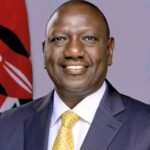


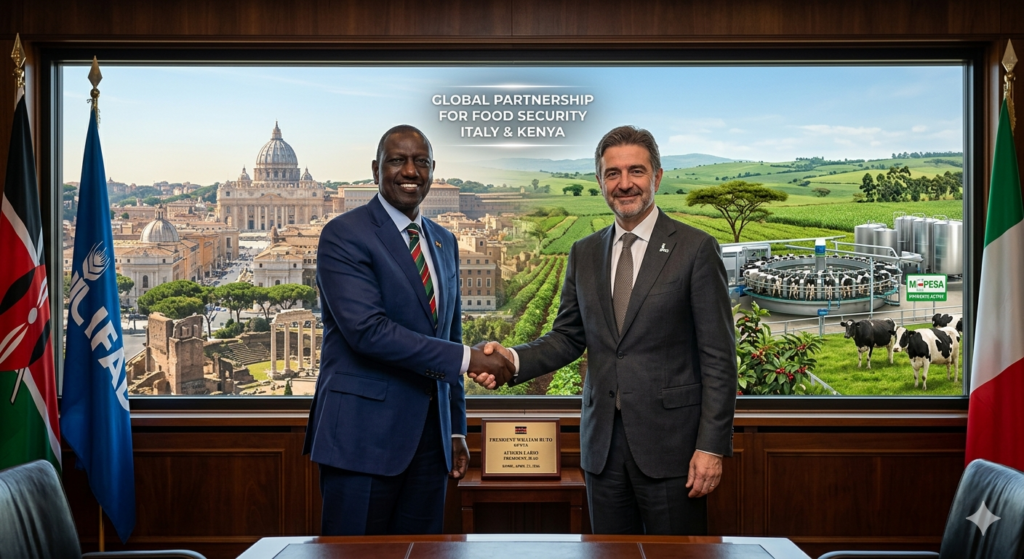
William Ruto has reaffirmed the central role of agriculture in Kenya’s economy, noting that the sector remains the largest employer and a key driver in efforts to reduce poverty and accelerate development.
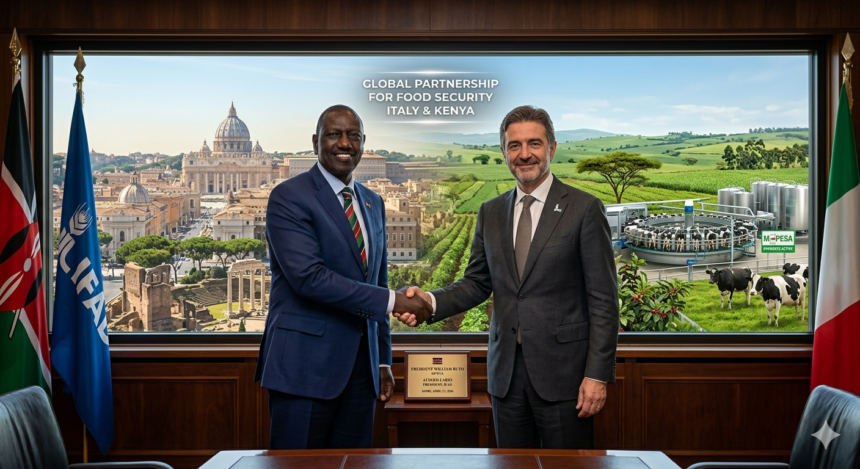
Speaking during a meeting in Rome with Alvaro Lario, President of the International Fund for Agricultural Development (IFAD), Ruto said the government is focused on strengthening agricultural productivity and improving farmer incomes through targeted investments and partnerships.
The president highlighted ongoing collaboration with IFAD, including a $40 million (KSh5.2 billion) investment aimed at supporting Kenya’s dairy sector. The funding is expected to enhance production capacity and improve value chains for dairy farmers.
Ruto also welcomed plans for a second phase of IFAD support valued at $263 million (KSh34 billion), which is set to be rolled out over the next three years. The programme is designed to expand financing options for small-scale farmers and support the transformation of agri-food systems.
According to officials, the initiative will focus on improving access to credit, boosting productivity, and promoting innovation among farmers. It is also expected to strengthen resilience in the face of climate-related challenges affecting agricultural output.

Agriculture remains a cornerstone of Kenya’s economy, contributing significantly to employment and rural livelihoods. Government efforts have increasingly focused on modernising the sector through technology adoption, improved inputs, and expanded market access.
Stakeholders say partnerships with international institutions such as IFAD play a crucial role in supporting long-term agricultural development, particularly for smallholder farmers who form the majority of the sector.
The meeting in Rome underscores Kenya’s continued engagement with global partners to mobilise resources and expertise for agricultural transformation. Officials indicated that implementation frameworks for the new funding phase will be outlined in the coming months.

Further developments are expected as the government and IFAD advance plans to support farmers and enhance food security across the country.