


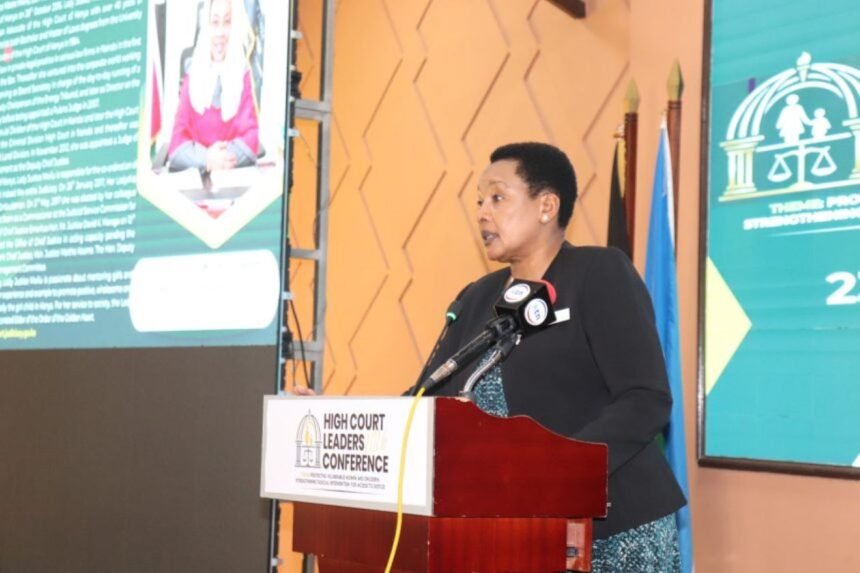
Deputy Chief Justice Philomena Mbete Mwilu has challenged High Court judges to strengthen judicial responses in cases affecting vulnerable women and children. Speaking at the opening of the High Court Leaders Conference in Naivasha, the Deputy Chief Justice cited rising incidents of sexual and gender-based violence (SGBV) and persistent structural barriers as urgent reasons for systemic reform.
Judicial Responsiveness and the STAJ Agenda
The Deputy Chief Justice emphasized that the Judiciary must adopt a humane and constitutionally grounded approach to ensure justice is accessible, fair, and timely. She noted that the mere existence of courts does not equate to access to justice if the enforcement of rights and delivery of remedies remain ineffective.
Central to her address was the Judiciary’s “Social Transformation Through Access to Justice” (STAJ) agenda. Mwilu stressed that protecting vulnerable groups is a mandatory constitutional duty anchored in the Bill of Rights, rather than a discretionary act by judicial officers. She called for court processes that prioritize dignity, guarantee confidentiality, and minimize delays that often deter victims from seeking legal redress.
Addressing Gender-Based Violence and Femicide
Expressing grave concern over the increasing cases of gender-based violence, including femicide, Mwilu called for a coordinated, multi-sectoral response to the crisis. She referenced the ongoing work of a specialized task force chaired by former Deputy Chief Justice Nancy Baraza, highlighting the Judiciary’s role in strengthening adjudication and institutional reforms to better handle such sensitive cases.
The Deputy Chief Justice also flagged the low participation of women in court processes. She attributed this trend to structural challenges, including high costs, social stigma, and the fear of retaliation. Mwilu urged the assembled judges to critically interrogate whether current court designs are adequately responsive to these harsh social realities.

Protection of Children’s Rights
On the issue of children’s rights, the Deputy Chief Justice cited findings indicating that more than half of Kenyan children face multidimensional poverty. This economic vulnerability directly limits their access to essential services and the formal justice system.
Mwilu advocated for the implementation of child-sensitive procedures and improved case management. She specifically called for the creation of court environments that do not deepen the vulnerability of minors, ensuring that the legal process itself does not become a secondary source of trauma for child litigants or witnesses.
Multi-Stakeholder Support for Reforms
The conference, themed “Protecting Vulnerable Women and Children: Strengthening Judicial Intervention for Access to Justice,” received further support from other senior judicial figures. Supreme Court Justice Smokin Wanjala noted that while Kenya’s legal framework—including the Children Act and the Sexual Offences Act—is robust, the primary challenge remains consistent enforcement.

High Court Principal Judge Eric Ogola challenged judicial officers to conduct a self-assessment on whether justice is truly being realized for vulnerable groups. He noted that gaps in service delivery, particularly in gender-based violence and child-related disputes, must be closed through proactive judicial intervention.
Expected Developments
The Naivasha conference is expected to result in a set of strategic reforms aimed at strengthening jurisprudence and institutional practices. These include the development of more inclusive justice modules and the strengthening of coordination between the Judiciary and other actors in the justice sector. The outcomes will likely inform future training for judicial officers on handling cases involving vulnerable populations with greater sensitivity and efficiency.