


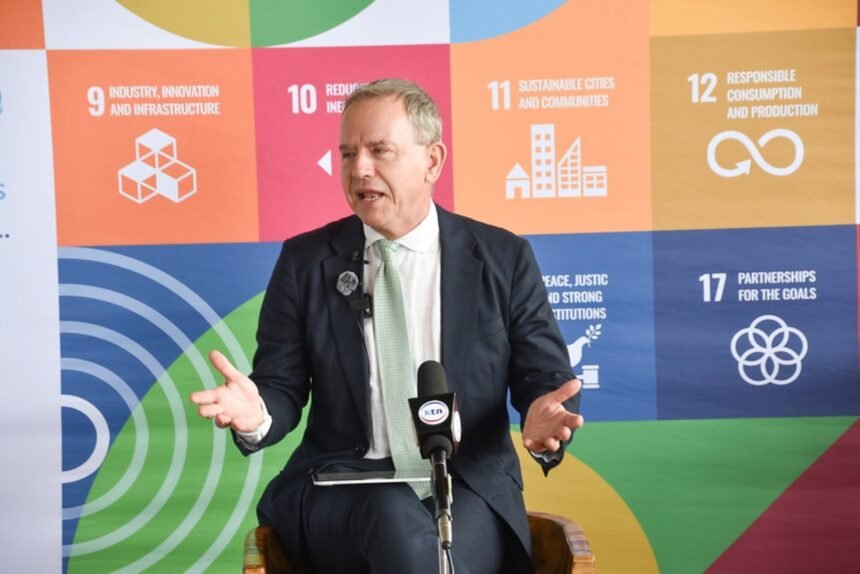
The outgoing United Nations Resident Coordinator in Kenya, Dr. Stephen Jackson, has lauded the country’s development trajectory while issuing a candid assessment of the hurdles remaining in the quest to achieve the 17 Sustainable Development Goals (SDGs) by 2030. Speaking at the UN Complex in Nairobi on Wednesday, Dr. Jackson rated Kenya’s overall performance at a six or seven out of ten, noting that while some sectors are thriving, others remain vulnerable to global shocks.
Strategic Gains in Green Energy and Health
Dr. Jackson highlighted Kenya’s leadership in renewable energy as a standout achievement. With over 90 percent of the nation’s electricity currently generated from green sources—primarily geothermal, wind, and solar—Kenya serves as a global model for climate-conscious industrialization.
Significant strides were also noted in the social sectors. Under the UN Sustainable Development Cooperation Framework (2022–2027), collaborative efforts led to the vaccination of 17 million children against typhoid and 5 million against measles and rubella. Furthermore, nearly 1.9 million people were reached through education and skills programs, while 2.4 million benefited from the Inua Jamii cash transfer initiative, a cornerstone of Kenya’s social protection net.
The Impact of Global “Headwinds”
Despite internal progress, Dr. Jackson warned that Kenya, like much of the world, is currently off track to fully meet the 2030 targets. He attributed this stagnation to a “triad of challenges”: the lingering economic aftereffects of the COVID-19 pandemic, the accelerating climate crisis, and rising international conflicts.
Specifically, he pointed to the current conflict in the Middle East as a direct threat to Kenyan households. “We have a conflict right now in the Middle East that is putting the prices of food, fuel, and fertilizer in Kenya at risk of increasing because of a conflict that has nothing to do with Kenya,” he remarked. He characterized the recent global funding cuts to UN operations as a “failure of solidarity” that has a material impact on the lives of the most vulnerable.
More Read

Addressing the Financing and Climate Gap
A recurring theme in the envoy’s reflection was the “financing gap.” Dr. Jackson emphasized that traditional foreign aid is no longer sufficient to meet the trillions of dollars required for the SDGs. He called for a shift toward “catalytic” funding, where limited UN resources are used to unlock massive private sector investments and domestic taxes.
He also flagged the high cost of borrowing for developing nations as a systemic barrier. “If Kenya could access finance at the same rates as developed countries, it would transform its development trajectory,” he noted.
Regarding environmental concerns, Dr. Jackson linked the increasing cases of urban flooding in Nairobi to inadequate drainage and rapid, unplanned urban development. To combat these trends, the UN recently secured $20 million (approximately Ksh 2.5 billion) to expand climate-resilient water access for over one million Kenyans in vulnerable regions.
More Read

A Global Hub and a Resilient People
Reflecting on his tenure and his history with the country dating back to the 1980s, Dr. Jackson underscored Nairobi’s importance as one of the four global UN headquarters. He noted that as the Global South becomes more influential, Kenya’s role as a diplomatic and economic hub continues to grow.
He concluded his remarks by praising the “resilience and optimism” of the Kenyan people, describing his time in the country as an immense privilege. “This is a society that has gone from strength to strength. Kenyans are resilient, hardworking, creative, and optimistic,” he said, expressing confidence that the country’s best years remain ahead.
Key UN Kenya Achievements (2025)
- Health: 22 million children vaccinated; 500,000 adolescent girls accessed reproductive health services.
- Food Security: 9 million people received nutrition support; 7 million farmers registered for streamlined fertilizer distribution.
- Water & Climate: 955,811 people accessed safe water; 197,780 farmers supported with climate-smart tech.
- Economy: 90,133 entrepreneurs trained in low-carbon and circular economy sectors.