


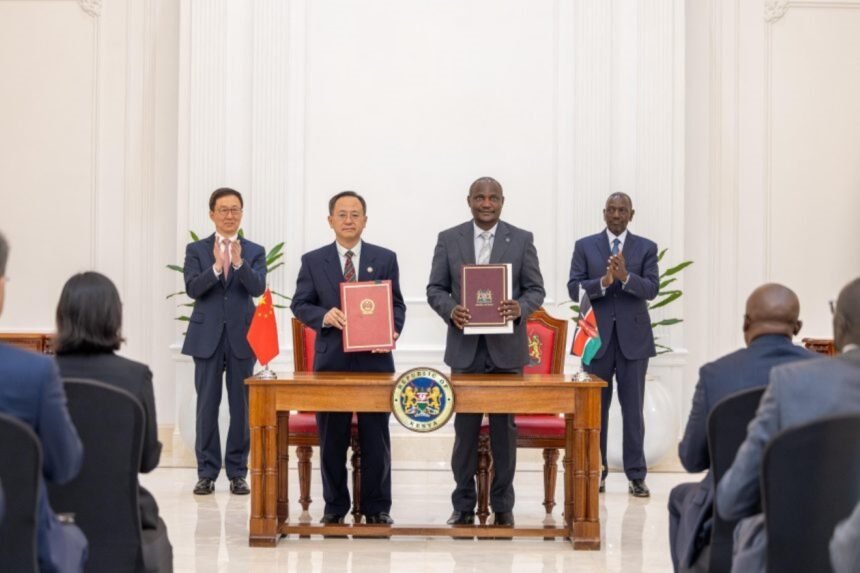
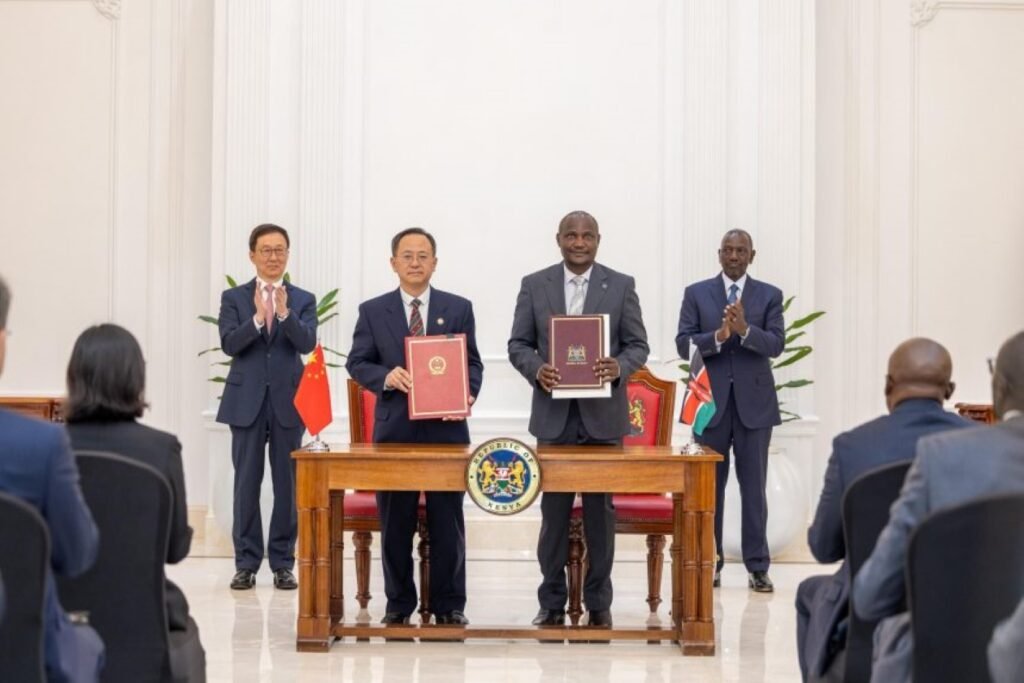
Kenya and China have formalized four Memoranda of Understanding (MoUs) aimed at deepening bilateral relations and expanding economic cooperation. The agreements, which cover trade, agriculture, and infrastructure, were signed following high-level talks between President William Ruto and China’s Vice President Han Zheng at State House, Nairobi.
Economic Partnership and Market Access
A central component of the new agreements is the “Early Harvest Arrangement” on economic partnership. This framework is designed to rebalance trade between the two nations by providing Kenyan products with expanded access to the Chinese market.
President Ruto confirmed that under the Framework Agreement on Economic Partnership for Shared Development, Kenyan goods will begin entering China under a duty-free and quota-free status starting in May 2026. This move is expected to provide a significant boost to Kenya’s agricultural exports, particularly for producers of avocado, macadamia nuts, and other horticultural products that have seen growing demand in Asia.
Strengthening Agricultural and Livestock Ties
The MoUs specifically target cooperation in the agriculture and livestock sectors, which remain the backbone of the Kenyan economy. These agreements are intended to facilitate technical exchanges, enhance value addition in the livestock value chain, and improve the quality standards of Kenyan produce to meet international requirements.
By aligning agricultural policies and sharing expertise in food security, the two nations aim to create a more resilient trade corridor. The cooperation is expected to involve investments in cold-chain logistics and processing facilities, which will help reduce post-harvest losses for Kenyan farmers.
More Read

Infrastructure and the SGR Extension
The diplomatic talks also highlighted the ongoing success of infrastructure projects developed under the Public-Private Partnership (PPP) framework. President Ruto noted that the collaboration has been instrumental in delivering large-scale projects that enhance regional connectivity.
Key among these is the recently launched extension of the Standard Gauge Railway (SGR) from Narok to Kisumu and Malaba. This rail link is a critical artery for the Northern Corridor, facilitating the movement of goods from the Port of Mombasa to the Ugandan border. Additionally, the leaders discussed progress on the Rironi-Mau Summit highway, another vital infrastructure project aimed at decongesting the main transport artery to Western Kenya.
Innovation and Green Energy
Beyond traditional sectors, Kenya and China are expanding their partnership into future-oriented industries. The MoUs encompass collaboration in digital innovation, intelligent transport systems (ITS), and green energy.
More Read
President Ruto emphasized that the goal of these partnerships is to deliver tangible benefits to citizens through advancements in manufacturing, healthcare, and education. By leveraging Chinese expertise in renewable energy and digital infrastructure, Kenya seeks to accelerate its transition to a green economy and enhance its position as a regional technology hub.
Expected Developments
With the duty-free status set to take effect in May, the Ministry of Investments, Trade and Industry is expected to issue guidelines for Kenyan exporters looking to tap into the Chinese market. Furthermore, technical teams from both countries will begin the implementation phase of the agricultural MoUs, with a focus on establishing joint research initiatives and trade facilitation offices to monitor the progress of the shared development framework.


